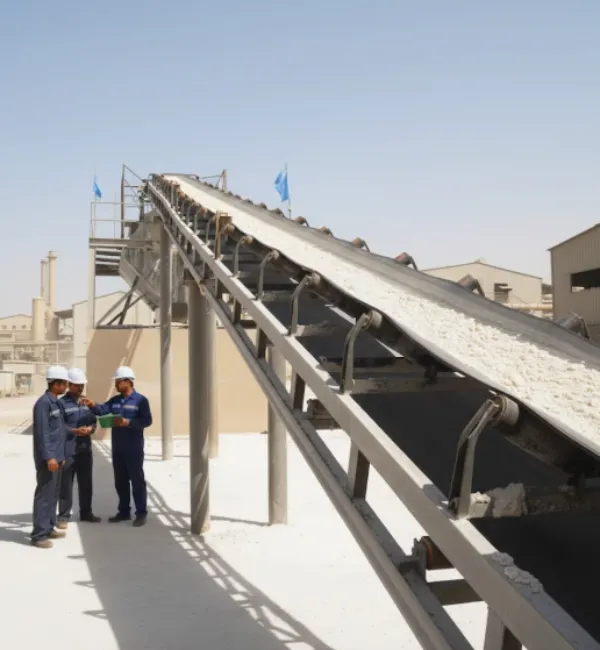
Material movement often receives less attention than pelletizing, granulation, or drying, yet inefficient transfer between machines can restrict an otherwise capable production line. A properly selected Belt Conveyor System helps move fertilizer material continuously between processing stages while reducing repeated manual handling.
For manufacturing facilities in Nagpur, conveyor selection should reflect the actual plant layout, material properties, and required throughput.
Start With the Material Being Conveyed
Not every fertilizer material behaves the same way. Fine powder, moist compost, freshly formed pellets, dried granules, and screened finished product have different handling characteristics.
Before selecting a conveyor, identify:
- Material type
- Bulk density
- Moisture level
- Particle or pellet size
- Required transfer rate
- Transfer distance
- Inclination
- Loading and discharge points
These factors influence belt width, speed, drive requirements, and conveyor configuration.
Conveyor Capacity Should Match the Line
A common planning issue occurs when the main processing machine receives most of the attention while conveyors are treated as secondary equipment.
Consider a granulator producing material continuously. If its discharge conveyor cannot remove output at a corresponding rate, accumulation can interrupt production. Similarly, irregular feeding into a dryer or screen can affect equipment performance.
Conveyor capacity should therefore be coordinated with upstream and downstream machines.
Layout Matters as Much as Capacity
Factory floor space can determine whether a production line operates efficiently.
A practical conveyor layout should provide smooth material transfer while maintaining sufficient access for inspection, cleaning, and maintenance. Excessive transfer points should be avoided where possible because every additional drop or transition can increase opportunities for spillage and pellet damage.
Manufacturers should also evaluate whether an inclined or horizontal configuration is more suitable for each stage.
Belt Conveyor Compared With Manual Handling
Small plants may initially rely heavily on workers to move material. As production increases, this can become inefficient.
A conveyor can provide:
- Continuous material movement
- More consistent equipment feeding
- Lower dependence on repetitive manual transfer
- Better coordination between production stages
- Reduced material accumulation around machinery
This does not eliminate the need for operators. Instead, it allows personnel to focus more on monitoring, process control, quality checks, and equipment operation.
Planning for Fertilizer Plants in Maharashtra
Rk Metal N Engineering manufactures industrial equipment in Nagpur for fertilizer processing and material-handling applications. When planning conveyors, the company and plant operator need to consider the entire process rather than specifying an isolated belt length.
For manufacturers serving Maharashtra's agricultural sector, production requirements may change as product volumes expand. It can therefore be useful to consider future equipment additions when planning conveyor routes.
A good belt conveyor is not simply a belt connecting two machines. It is part of the process-control system because its speed and capacity influence how consistently material reaches each stage.
When conveyor dimensions, loading points, discharge positions, and throughput are matched correctly, the fertilizer line can operate with smoother material flow and fewer avoidable interruptions.
Keywords