Drying is one of the most important stages after fertilizer pelletizing or granulation. Excess moisture can affect product strength, storage stability, screening efficiency, and packaging. A Rotary Drum Dryer is commonly considered for continuous bulk processing, but manufacturers should evaluate whether its operating characteristics match their specific production needs.
For fertilizer units in Nagpur and elsewhere in Maharashtra, the decision should be based on material behaviour and production requirements rather than equipment size alone.
How Does a Rotary Drum Dryer Work?
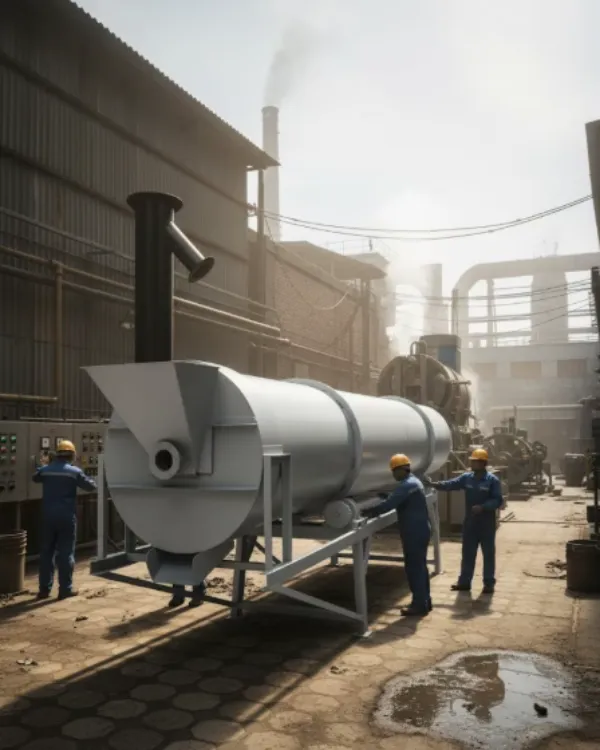
A rotary dryer generally uses a rotating cylindrical drum to expose continuously moving material to heated air or gas. As the drum rotates, material is lifted, mixed, and moved through the drying zone.
This continuous movement can make rotary systems suitable for processing substantial quantities of granular or pelletized material.
The actual drying performance depends on factors including:
- Initial moisture content
- Target final moisture
- Material particle size
- Feed temperature
- Heat input
- Airflow
- Residence time
- Drum dimensions and operating speed
Changing one parameter can influence several others.
When Does Rotary Drying Make Sense?
Rotary drying can be useful when the production process requires continuous handling of bulk fertilizer material and the feed is compatible with tumbling inside a drum.
Manufacturers should consider it when they need a drying system that integrates with upstream granulation and downstream screening.
However, capacity alone should not determine the decision.
A dryer that is oversized for actual production can create unnecessary capital and operating requirements. An undersized unit can become a bottleneck even if the pelletizer or granulator has sufficient capacity.
Evaluate the Complete Production Line
Suppose a fertilizer granulation machine can process material faster than the dryer can remove moisture. The entire plant will eventually operate at the dryer's lower effective capacity.
The same principle applies to screening and conveying.
Before selecting a dryer, compare:
- Granulator output
- Moisture entering the dryer
- Required moisture reduction
- Dryer throughput
- Screening capacity
- Conveyor capacity
- Packaging rate
This gives a more realistic view of overall plant output.
Consider Local Operating Conditions
Nagpur experiences significant seasonal temperature changes and a monsoon period that can influence ambient humidity. Although industrial drying systems are engineered around controlled operating parameters, environmental conditions and incoming material moisture still deserve consideration during process planning.
Rk Metal N Engineering works with industrial processing machinery in Nagpur and can evaluate drying equipment as part of a broader fertilizer production arrangement.
The right drying system is ultimately the one that matches the material, production rate, heat requirements, available space, and downstream process. Rather than treating drying as an accessory after granulation, manufacturers should consider it a core production stage.
A properly matched dryer helps create the conditions needed for effective screening, storage, and packaging while preventing drying capacity from limiting the rest of the fertilizer production line.
Keywords